
How to Create a Brand Offer that Attracts Loyal Customers
Introduction
Loyal customers aren’t just attracted by louder marketing or bigger discounts; they come from offers that clearly solve a real problem and make people feel understood. This guide shows you how to create brand offers that do both, without copying competitors or chasing trends.
summary
You craft a brand offer that draws in loyal customers by matching what you sell with what you stand for. An irresistible offer tackles one clear problem, provides a meaningful emotional experience, and shows its worth through consistent delivery on its brand promise. When your offer supports your brand promise, customers begin to see your company as the only logical option.
Brand Promise vs Brand Offer: What’s the Difference?
quick answer
Your brand offer is basically how a business delivers on their brand promise. Brand offers highlight what makes a company stand out, with specific bundles of services or products, while the brand promise is all about the emotional impact and the overall customer experience they aim to deliver. Brand promises are part of your big-picture brand strategy, while brand offers are more about the tactics that support that overall experience.
your brand promise
Your brand promise is the emotional expectation you set for your customers when they interact with your brand. When your business talks about the brand promise, it shifts the focus to the genuine relationship you have with your clients. It's less about how you solve the problem and more about why. Think of your brand promise as the social contract you sign with your clients every time you walk into a room and talk about your business. You're making sure there's a consistent experience in terms of quality of service, price, speed, and communication across all channels—website, social media, email, even phone calls.
Your brand promise is a core element of your overall brand story which people emotionally connect with. It’s important that your business has a very strong “why” anchoring the purpose of the business’s existence and mission.
When developing a strong brand promise, there are seven core elements to consider:
Emotional Benefit
What do people feel after working with you?
Core Belief/Philosophy
What truth or value do you stand for?
Experience Consistency
What are you delivering this promise at every touchpoint?
Reputation
How should people perceive you over time?
Brand Character
What personality should customers expect?
Why It Matters
What is the deeper reason customers choose you, beyond features (your “because”)
The parts of a brand promise are more about the emotional experience you give to clients and how you build relationships. A brand promise always shapes how you create your brand offers, because without core beliefs, character, & tone, your brand will come off as an actor looking to make a quick buck from their audience.
your brand offer
It’s no secret that when you start a business, there’s always going to be some competition no matter what industry you’re in. Your brand offer is how you prove and deliver on your brand promise; through specific services, proof points, or value-packed packages. The best thing about a brand offer is that you can have multiple ones to support your overall brand experience. Most people tend to think of an actual offer itself — like service bundles, special deals, or discounts. However, brand offers aren’t just about product or service packages. They can also include case studies showing your process, testimonials that build social proof, & content marketing that adds value before selling.
No matter what methods your business relies on, your brand offer is all about showing that your brand promise is viable. If your business suddenly starts promising to fix clogged sinks, but all your offers talk about fresh pastries, you probably shouldn't quit your day job at the bakery just yet. No one has time to hire a confused plumber when their kitchen is flooding.
It’s important to note that a brand offer isn’t a catchy tagline or marketing jiggle (sometimes they do end it that way). According to Fabrik.com, there are three big questions every business should ask: who are they, what do they do, and why should anyone care. Companies often stumble on that last one because they’re not sure why clients should choose them over the competition, other than just saying “Well, I’m just better!” Sadly, that’s not a strong enough reason for people to take on financial risk.
In order to craft a strong brand offer, a company needs to consider the seven elements below:
The Villain (Core Problem)
What pain point or challenge is your customer trying to overcome?
The Solution (Your Product or Service)
What exactly do they get? (Deliverables, features, method)
Transformation/Outcome
What measurable or emotional result will they walk away with?
Target Audience
Who is this offer for? (Demographics, psychographics, niche)
Unique Method or Framework
What parts of process are unique to your business?
Messaging & Positioning
How it’s framed, packaged, and communicated (often includes hook, promise, CTA)
Pricing & Value Stack
What’s the investment, and what’s included?
Notice how these questions are a bit more “technical,” focusing on the specific physical and emotional problems your customers are dealing with and what solutions your business can offer. Other questions get into value versus pricing and also encourage you to think about your own unique problem-solving methods. Building a solid brand offer means really understanding your customer’s problems inside and out, and coming up with a simple, easy-to-implement solution they can quickly see results from. You’ll want to prioritize simplicity in your sales language directly speaking towards the benefits that your clients will receive and the risks they face if they choose to ignore their problems.
Why Does Every Business Need A Brand Offer?
Quick Answer
Every business needs a brand offer because it helps them stand out from the competition, build trust, and foster brand loyalty. Without a brand offer, customers would have to take on more risk when doing business with your brand. Why do that when your competitors have their own brand offers already showcasing their ability to deliver high quality and consistent results?
Reason #1: Differentiate themselves from competitors
Having a clear brand offer (or offers) helps your business stand out from the competition by showing what you're really good at. It allows you to create personalized experiences, target specific issues, and fix them with custom solutions like special packages, free resources, or even sharing success stories from clients. While competitors might offer similar services and solve similar problems, your brand offer gives people a chance to see what it's like to work with you and your team (often with less or no risk).
Reason #2: build trust with consumers
Your brand offer is all about taking action to follow through on your promise. Every time you prove your results with solid evidence, your audience notices, and your reputation gets a boost. Without these strategies, your audience would have to take on the risk of trusting you. Picking the right ways to show your actions helps you control the overall brand experience for your customers, making it more cohesive and consistent. Some delivery methods work better than others depending on your business and industry. Regardless, trust is built through patience and consistency.
Reason #3: Foster loyalty in your relationaships
It's human nature to want to create a kind of "tribe" where we bond over familiar relationships. When you put out successful brand offers, you're building new connections and making the ones you already have even stronger through what you do. Customers never forget how you made them feel when they interacted with your brand. Treat them well, and they can turn into brand advocates who refer their own friends and family to your growing business. As long as you keep up the positive cycle of delivering on your promises, you'll see leads steadily coming in from happy customers.
What elements make an offer irresistible to loyal customers?
Quick Answer
An irresistible offer tackles a genuine problem while giving an emotionally satisfying experience that matches a customer’s identity. It clearly shows the transformation or value, backs it up with trust signals like social proof, and is easy to grasp. Good post-purchase support then strengthens the connection, turning happy customers into loyal fans.
LEt’s talk biology
There have been lots of studies about consumer behavior showing that people don’t buy based on logic, but rather on emotions. Our brains look for products and services that can trigger our “feel good chemicals,” usually called dopamine. “Dopamine can motivate people to keep seeking feel-good activities or those with a promised reward,” explains ExperienceInvestigators.com. Some examples of brand-related activities include discounts, new sales, or just a smooth shopping experience. When brands tap into these natural chemicals through brand experiences, they can use biology to build long-lasting relationships with their customers. Some common strategies brands use to directly trigger these chemicals include loyalty programs, referral incentives, or even extra freebies after a purchase. These actions activate your customers’ reward centers in the brain and help them connect with your brand.
So, what does any of this have to do with crafting a brand offer? Your brand offer will leverage human biology to activate the rewards centers to create a product or service that not only solves problems but also feels good to use.
The elements of an irresistible offer
Identity Alignment
Your offer will need to directly speak to your customers’ value set and personal identity. It’s more than just researching demographics, you need to understand what your customers’ dreams, fears, and goals are before launching that offer.
Emotional Connection
Are you talking about the symptoms of the problem or the solution? Does your brand get the 3 layers of conflict that your audience members are dealing with, or is your copy just scratching the surface? Keep in mind, people don’t buy based on hard facts. They buy when their emotional experience is acknowledged.
Clear Transformation or Benefit
People aren’t really trying to think more than they have to. Our brains are hit with ads constantly trying to sell us stuff nonstop. Your brand needs to communicate in straightforward terms so the brain can easily understand the benefits of working with you—whether it’s saving money, building community, gaining status, or reaching a certain goal.
Value Justification
What metrics can folks use to know that your offer has hit its target? Business owners call this ROI (return on investment), but you can think of it as the goalpost. Are you promising growth on social media? Maybe your offer helps clients save time or other resources. Regardless, just make sure the metric is clear and easy to measure.
Social Proof
Testimonials and business reviews are important shows of authority and expertise when launching an offer. Happy customers have the opportunity to share their experience with others through reviews or ratings letting others know the real experience behind the services. The more social proof, the better because it shows that you can deliver consistent results.
Post-Purchase Experience
Keeping the relationship alive after the sale is the most important part. Make sure you have CRM systems set up so you can check in with past clients. This can be done through email lists or by sending personalized messages during holidays or special milestones. It's always better to customize your messages based on the client and their experience with your business. Don’t be afraid to go to lunch or grab a cup of coffee with past clients.
5 Mistakes to Avoid When Crafting Your Brand Offer
Quick Answer
The five common mistakes that weaken offers includes: trying to appeal to everyone, solving the wrong problem, taking on too many issues at once, not clearly explaining what's at stake, and copying your competitors. Great offers stay focused, centered on the audience, and stand out clearly.
Mistake #1: Not Understanding Who Your Client Is
The biggest mistake brands make when creating special offers is trying to talk to everyone instead of speaking to a specific person. To build a solid foundation for your offer, you need to know who your customer is, what values matter to them, and what emotional needs they're trying to address. You can do research in different ways, but a common approach is interviewing your target audience to see how they see themselves and their problems.
Mistake #2: Solving the Wrong Problem
Companies can sometimes miss the mark by creating offers that don’t solve the actual problem their clients are facing. This often happens when businesses assume the diagnosis or try to put themselves in their clients’ shoes. Assumptions can lead to twisting your own interests and identity into an offer YOU would buy, instead of what your customer actually needs.
Mistake #3: Picking More than One Villain
Talking about too many problems at once can lead to a shallow fix that doesn’t really make a difference. It’s super important for a business to figure out what root problems they’re solving and create specific offers for each one. Another reason to stick to one problem per offer is to keep things clear and make decisions faster. Buyers have short attention spans and don’t want to waste energy trying to figure out what you’re offering. Keep things short and simple.
Mistake #4: Not Understanding the Stakes
The question that trips up most business owners is “Why should I care?” Stakes are the risks your clients face if they decide not to use your solution for their problems. These directly hit on your customers’ fears and worries about their own issues. When you understand the risks your customers are facing and speak directly to those fears, you show that you truly understand the full scope of the problem. You’re not just another service provider; you’re a problem-solving partner ready to help your customers reach their goals.
Mistake #5: Copying Competitors
Companies often fall into the trap of just copying their competitors. Afterall, whatever formula they’re using is bringing great traffic so it should work for you. The problem is that when you copy and paste the same offers, your business is shown to have a weak and disingenuous value proposition. On a digital megaphone, you’re announcing to the market that the only thing special about your business is your ability to steal from competitors. Being known as the “copy-cat competitor” won’t make your target audience excited to buy from you (unless you’re at a crazy discount).
Free Resource Drop
Quick Answer
I put together the worksheet “Understanding the Real Problem” to help business owners craft brand offers that match their brand promise, making for a consistent brand experience. Whenever you create a new offer, just download the worksheet below and work through each exercise.
What is this worksheet?
Your “Understanding the Real Problem” worksheet is meant to help you line up your brand offer with your brand promise. It makes sure that what you’re offering (what you sell) actually matches what you stand for (your promise). The first page is just a sample showing how to answer the questions so you can get the most out of the worksheet. Take some time to really think about the core problems you’re solving as a business, and then map out the physical, emotional, and philosophical experiences your customers go through. When you get a clear picture of the full scope of the problem you’re addressing, you’ll be able to craft copy that really speaks to your audience’s goals.
How this worksheet
The idea is to reuse this worksheet for each brand offer. It could be for special packages or deals your company is planning to launch, or even how you present your case studies and testimonials.
Each unique offer you craft (a service, product, program, etc.) may:
Solve a different villain/problem
Target a different audience segment
Deliver a different outcome or transformation
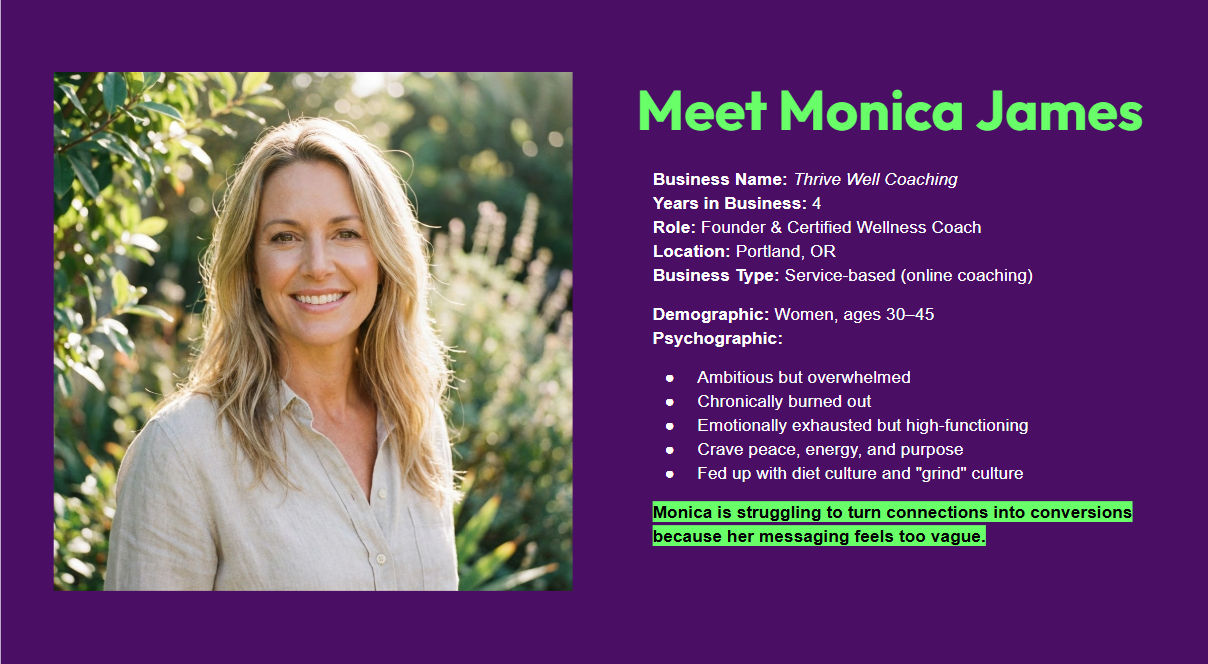
The first page is a sample study using our fake founder persona, Monica James. Monica runs an online coaching biz called “Thrive Well Coaching,” where she helps young women (30-45) take back their physical, emotional, and mental health from the stressful grind culture often found in high-achieving careers. She's dealing with a problem herself, though—Monica still finds it hard to clearly communicate to her target audience why they should choose her brand’s offers (like workshops and coaching). You can ask Monica those questions on page one and read her answers like you're a friend trying to come up with better copy.
FAQ: More about brand offers
-
Your brand offer answers the question “What will I get?” while your brand unique value proposition explains “How are you different from competitor x, y, & z?” While people have used brand UVP & brand offer interchangeable, they are different. The two together when developing services and writing sales copy, but your brand offer is mainly about the tangible tactics you use to back up your brand promise. Your brand unique value proposition is typically a strategic statement that makes your clients care about your services.
-
You’ll know your offer is aligned with your brand when you can answer this question: “Does this offer give my audience the intended emotional experience while also solving their core problem?” If your offer creates the emotional experience but doesn’t actually fix the problem—or solves the problem without giving the right feeling—it’s not fully in line with your brand promise.
-
Yes! Most brands have several offers created to focus on isolating different problems that might overlap and create complex pain points. Realistically, most companies solve an array of issues for their customers, but struggle to convey those issues through copy and sales because they aren’t addressing the root issue. Every offer should have only ONE core problem (villain) for the sake of clarity.
-
Storytelling elements allow companies to engage with their customers on a deeper level without overcomplicating their communications. Everyone understands the basics of a good story: main character, villain, conflicts, master plan, & the outcome (success or failure). Speak with these elements!
-
You speak on the emotional experience that your process and outcomes creates rather than solely focusing on the general solution. Most competitors will overlap services, but your experience is uniquely your own just like your ownership over company processes.
Key Takeaways
Your brand promise is the emotional expectation you set for your customers when they interact with your brand.
Your brand offer is how you prove and deliver on your brand promise; through specific services, proof points, or value-packed packages.
Your brand promise and offer team up to support your brand strategy (the overall plan for your brand) by turning your clients’ emotional connections with your brand into clear next steps.
Every business needs a brand offer because it helps them stand out from the competition, build trust, and foster brand loyalty.
An irresistible offer tackles a genuine problem while giving an emotionally satisfying experience that matches a customer’s identity.
Elements of your brand offer should always include identity alignment, emotional connection, a clear transformation/benefit, value justification (ROI), social proof, and a post purchase experience.
The five common mistakes that weaken offers includes: trying to appeal to everyone, solving the wrong problem, taking on too many issues at once, not clearly explaining what's at stake, and copying your competitors.
The “Understanding the Real Problem” worksheet is meant to help you line up your brand offer with your brand promise. It makes sure that what you’re offering (what you sell) actually matches what you stand for (your promise).
Reuse the worksheet for each offer that you create to understand how to attract a loyal customer base.
work with us
*
work with us *

