
Brand Ecology: Designing Brands With Purpose & connection
Introduction
Most business owners pour everything into their product or service, then slap a logo on it and call it a brand. But branding isn't a finishing touch. Branding is the living, breathing ecosystem that either attracts your ideal clients or quietly repels them, often without you even knowing it.
At Spunky Psyche, we built the Brand Ecology Method to fix exactly that. It's a strategic framework that combines research, storytelling, and design to create brands with real emotional depth; the kind that scales, connects, and grows with your business instead of holding it back. In this post, we're pulling back the curtain on how it works, why it matters, and what it looks like in action.
summary
Brand Ecology treats your brand like a living ecosystem, one that needs research, storytelling, and design working together to thrive. Without all three, your brand goes off balance becoming too data-heavy, too emotional, or too visually disconnected to actually convert. The Brand Ecology Method walks you through three phases (Discovery, Strategy, and Expression) to build a brand that attracts aligned clients, scales with your business, and tells the right story at every touchpoint.
What Is Brand Ecology? (And Why Your Brand Is Already an Ecosystem)
quick answer
Brand Ecology is the idea that your brand isn't just a logo; it's a living system that interacts with every part of your business, from customer service to social media. Just like a natural ecosystem, every element plays a role in keeping your brand healthy and functioning. When one part goes off balance, the whole system feels it.
The word “ecology” is defined as the scientific study of how living things interact with each other and their physical environment. This part of biology looks at entire living systems to understand how everything affects nature—like forests, mountains, oceans, and so on. Basically, the idea is that everything has its role and does its part to keep the environment healthy and functioning.
Brand Ecology is kinda similar—your brand is like a mini ecosystem that lives, breathes, and changes within your business environment. Branding isn’t just about your marketing materials. Your brand is the whole relationship you build with your customers through various forms of communication and engagement; social media, email, phone calls, sale processes, and even customer service meetings. Your own ecosystem grows and adapts depending on how your business vision and leads your team into different market landscapes. Just like everyone has a “seat” in your business, each department has a part in your brand, working to keep those positive relationships with your customers intact.
At Spunky Psyche, we use Brand Ecology as a guiding principle to build purpose-driven brands to create strong ecosystems that work together regardless if it’s your customer service representative speaking with a customer or your CEO. Your brand isn’t simply a one-off project that you pay a design agency to build. Your brand is organic, dynamic, and uniquely yours.
How the Brand Ecology Framework Works: Research, Storytelling & Design.
Quick Answer
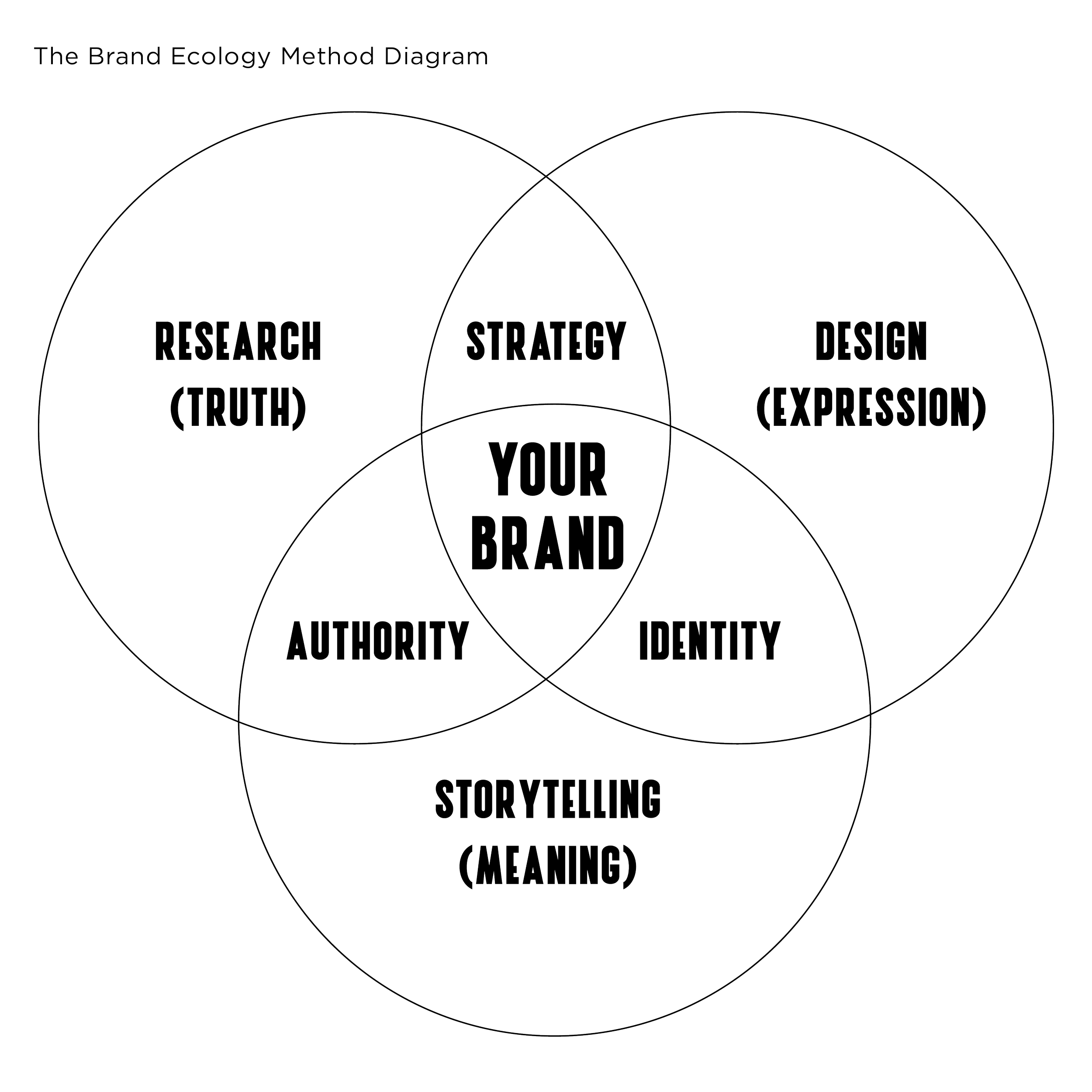
The Brand Ecology Framework blends three core elements (research, storytelling, and design) to build brands that resonate and convert. Each element shapes a key output: your brand strategy, identity, and authority. Miss one, and your ecosystem loses its balance and its power to build real trust with clients.
The Brand Ecology framework is built by combining three key elements: research, storytelling, and design. When these overlap, they shape your brand strategy, identity, and authority, which all impact how your brand ecosystem manifests in the market landscape. In other words, you are influencing your reputation by engaging with your customers intentionally through visuals, verbal & written communication, and actions. If one of these parts is missing, your ecosystem can go off balance—either being too focused on data and missing the emotional touch, too disconnected from reality to pull off solutions, or too driven by emotion to build trust with your customers.
research
Before you build a successful ecosystem, it’s really important to check out some of the successful examples already out there in your industry. Observation is a powerful tool that can help you get a sense of what others might expect or assume when they interact with different brands in the market space. This isn’t about copying, but about understanding how competitors are overcoming current challenges to reach their own audiences. Some things to look for during research include visuals (colors, fonts, symbols), sales messaging and language, channels of engagement, and how often they connect with clients. These four areas give us a clearer picture of what competitors are focusing on and what clients have come to expect as the industry norm. Our team calls this “brand profiling,” where we reverse-engineer competitors’ brands to see how they’re positioning themselves in the market. It can also give us clues on what kind of clients they are targeting and if those clients even align with the ecosystem that we’re attempting to build.
A good way to think about this is to consider your own assumptions—both physical and emotional—when thinking about different businesses. For example, when someone says “design agency,” most people already have an idea of what kind of person runs that kind of business—what they’re like, their attitudes, beliefs, and maybe even what that leader probably looks like. There’s some truth to those assumptions since our brains are wired to spot patterns for survival. But not all assumptions are accurate, and you can actually use some of them to surprise or comfort your audience.
Storytelling
This is the heart of every brand and helps customers connect emotionally and build a relationship with your business. When we talk about storytelling, we’re really focusing on your “why.” Your “why” is usually broad and also answers two other questions: “who” and “what.” Often, businesses struggle to communicate the emotional impact they bring to clients, which causes them to emphasize features instead of benefits. People don’t buy products or services—they buy the emotional relief they feel when you genuinely solve their problem.
We rely on research as a key foundation for building ecosystems because it helps us figure out what kind of clients are after this emotional transformation by spotting patterns in competitors’ language. Once you understand your client (who they are, what they believe, and how they see themselves), you can start crafting a compelling story that centers around them as the hero. Every brand is basically the guide trying to get their attention and help bring their story to a happy ending. Your story isn’t just about the design; it’s communicated across all parts of your business—sales, marketing, customer service, and even on social media.
Design
Finally, we get to the fun part. We take the data & storytelling template to spot opportunities and also figure out what makes the brand we're building strong before diving into designing a cool, impactful system. Since we're creating a brand to attract customers, we're still making systems that kind of confirm what people already expect. The creative juice kicks in when we start to push or pull in areas where our competitors aren’t willing to go.
For example, standard branding for medical clinics usually looks clean and minimal to give off a professional vibe. But we could switch it up with warmer colors instead of cool ones to create a subtle shift in energy when connecting with new clients. A brand might go for yellow or orange (but not red), keeping the color palette simple to help with contrast. If the usual colors are blue, white, and black, adding a warm color now sparks interest without turning people off. The goal is to activate curiosity, not to shock. Another subtle way to shake things up could be selecting different font combinations or creating more dynamic social media templates to gain traction on posts.
Why Brand Strategy Matters More Than You Think
Quick Answer
Most businesses hit a "brand gap" around years 2–3, when their scrappy early visuals and messaging can no longer support their growth goals. At that point, unclear or inconsistent branding actively costs you clients and opportunities. The Brand Ecology Method builds the kind of brand foundation that scales with you, so you're never caught outgrowing your own story.
Take a moment to think about all the effort and resources you've put into not just building your idea, but getting it to successfully launch into the market. It's pretty common for entrepreneurs to fund their own careers by picking up a second job until their business starts bringing in enough to live on. Some rely on investors for resources, but accessibility doesn’t eliminate the pressure to perform well in order to see a decent ROI. No matter how you’ve built it, you've invested your heart, time, and hard-earned cash. Now, just imagine how gut-wrenching it would be if, after the first few years of gaining traction, that progress suddenly came to a halt. But, Spunky Psyche, that would never happen to my business! How often does that really happen? Well, all the time actually.
After about 2-3 years of pretty good success, businesses often start thinking about expanding into new markets or reaching new clients, which is what we call a “brand gap.” The current visuals, messaging, and stories don’t quite hit the mark anymore because the new audience usually has higher or different expectations. Creatives can run into this too when trying to level up their packages or prices for white-label clients, but they often struggle because their branding doesn’t match the maturity or style of agencies that clients are used to working with. Any business, no matter the industry, can run into this issue when they've been relying on scrappy visuals and patchwork strategies to make it to the next year.
The Brand Ecology Framework helps business owners move beyond superficial branding and develop identities with real emotional depth. It also brings their team together and encourages target audiences to become part of a community rather than just a one-time transaction. When everything is designed with long-term goals in mind, scaling becomes second nature.
How We Bring a Brand Ecosystem to Life (From Discovery to Expression)
Quick Answer
Every Spunky Psyche project moves through three phases: Discovery, Strategy, and Expression. Discovery is about understanding your environment; Strategy turns those insights into a flexible brand system; and Expression is where visuals and voice come to life across every touchpoint. The goal is a brand that works with your team rather than against it so it doesn’t drain your resources.
Phase #1: Discovery—Observing the Environment
We always kick off each project by digging into the key details about your business goals, the current market landscape, and your target audience. This helps us clearly identify what's causing friction in your business and processes. Usually, this involves having some consultations, 90-minute discovery calls, and doing thorough market research to spot patterns, trends, and opportunities. Our aim is to get a full picture of your history so we can see how you've arrived at your current point and respect that to set you up for a successful future. No two businesses are alike, so each call is tailored to the founder’s current experiences. That said, some common questions we like to ask include:
What is your mission statement?
What is your vision for your brand/business?
What are your 5 characteristics or core values?
What emotional reactions do you aim to evoke through your brand?
Who founded your brand, and what inspired its creation? What is your brand’s purpose?
These questions are meant to find out more than just fun facts. We want to get a sense of your decision-making process and what motivates you, so every project fits naturally. If you're having trouble using the solutions, then they probably weren't the right fit for your company to start with.
Phase #2: Strategy—Designing the Ecosystem
Once we get a handle on your environment, we start designing the system that'll help your brand succeed in it. We blend emotional insights with strategic thinking—figuring out your values, positioning, personality, and messaging framework. This stage is about turning those intangible ideas into a solid, flexible foundation for your visuals and communication. That's when we begin working on brand profiling, brand strategy docs, and any frameworks. We keep the conversation open and ongoing, encouraging clients to give feedback on what works and what doesn't. Keep in mind, the main goal is to create methods that are actually easy to use in everyday decisions. We want our clients to feel comfortable telling their story because, at the end of the day, they’re the ones who have to live it. Common questions we used to guide this phase include:
What space do you want to own in the market? What are you willing to not do anymore?
What kind of relationships do you want with clients?
What is the simplest way to describe what you do and why it matters?
How should your messaging adapt across audiences or services?
Where might this strategy be difficult to implement?
These questions help our team catch any blind spots we might come across while working on the main decision frameworks for your brand. The first phase is all about gathering data, and the second phase is about creating the tools to put it into action.
Phase #3: Expression—Breathing Life
The final stage is often what most people think of when it comes to building a brand. This is the part where we start creating visuals and written content based on research and strategy to make sure your ecosystem grows in a way that's both dynamic and stable. Keep in mind that your branding is like the “clothes” your business wears to promote itself and says a lot about what your clients can expect. Your colors, fonts, patterns, and other design elements are used on social media, your website, emails, marketing materials, and pretty much anything that faces your clients. It’s all about making a strong impression that attracts your ideal clients and sparks the question, “How can we work together?” During this final phase, we’re considering these questions:
What should your brand signal in the first 3 seconds (premium, approachable, technical, bold, etc.)?
Who might this brand intentionally turn off?
What objections should this brand help reduce?
Where will this brand show up most frequently?
What formats or environments will challenge this system?
These questions help our team figure out where to focus your energy so your brand attracts the right people instead of turning them away. Your brand's goal is to weed out the "wrong" clients, making sure those who can really benefit from your services find YOU, rather than wasting time on projects you don’t want to take on.
5 Common Branding Mistakes That Are Costing You Clients
Quick Answer
The most common branding mistakes all share the same root cause: a brand built on tactics instead of strategy. The Brand Ecology Method addresses each of these from the foundation up, so your brand earns trust before you ever pitch a client. When your brand is built right, the right people find you (and the wrong ones filter themselves out).
Before Spunky Psyche was born, I spent around 5 years in the industry watching small businesses struggle to connect with their target audience. They had solid solutions and delivered great services that often outperformed their competitors. But I couldn’t figure out why people weren’t flocking to their businesses. That is, until I really started paying attention to how they were trying to tell their story. Turns out, their branding quality was holding back their growth. After witnessing company after company struggle then close, I noticed there were common mistakes that came up time and time again.
Mistake #1: Generic Branding Appeals To “Everyone”
A business that says it serves “everyone” is a business that serves “no one”. New companies often struggle to pick their niche because they’re afraid of missing out on opportunities, but in doing so, they just end up blending in as another faceless option among many, missing out on their ideal clients altogether. The funny part is, generic branding usually ends up being the most expensive branding your company will ever do, since you end up having to spend more time, money, and resources to reach the right people. The Brand Ecology Method kicks off by getting clear about your business’s story, values, and goals that helps your business feel unique and human.
Mistake #2: DIY Branding Makes Your Services Look Cheap
Founders are known for their resourcefulness and scrappy attitude that helps them thrive in tough marketing conditions. It's a great skill and totally essential for founders to turn big ideas into reality. But as their business grows, expectations get higher since bigger clients want bigger solutions. Unsurprisingly, people do judge a book by its cover, and if your brand looks “cheap,” folks often see that as immaturity, unprofessionalism, or just messy. Before you can send that next pitch deck to your big budget project, you’ve got to look the part to attract the right attention.
Mistake #3: High Traffic That Doesn’t Convert
Sometimes businesses grab a lot of attention with their visuals and sales tactics, but their brand doesn’t really turn customers into loyal fans. This usually happens when the brand experience isn’t consistent across different touchpoints, leading to mixed messages. As a result, leads tend to drop off from websites, social media, or even sales calls. It all comes down to the brand’s foundation: the brand strategy. The Brand Ecology Method lays a solid groundwork for each project so that the brand you build actually works, instead of making your team work harder in every area of your brand; marketing, sales, customer experience, design, etc.
Mistake #4: Old Systems Unable to Scale
One of the most key parts of building a brand is putting together solid frameworks that can grow with your team and serve as guides for strategy and decision-making. Companies that rush their designs into the market often only think about one side of what a brand is: visuals. Your ecosystem needs a strong “brain” to survive and adapt to new market conditions. Without good systems and frameworks in place, just one unexpected shift can knock your brand over, and competitors will leverage the opportunity. We create documents that give you structure and flexibility so you don’t feel stuck thinking in just one way.
Mistake #5: Inconsistent Branding Loses Opportunities
Consistency shows stability. If your brand isn’t cohesive across all touchpoints, it’s tough to build strong, meaningful relationships that lead to trust. If your customers don’t trust you, why would they buy from your team? It’s normal for founders to feel overwhelmed with so many ways to connect with their audience. A good strategy helps your team choose the best channels and come up with plans that are easy to follow through on and stay consistent with. Don’t miss out on chances just because your clients are left unsure.
Brand Ecology in Action: The BerryStrange Case Study
Quick Answer
BerryStrange needed a brand system as bold and weird as their candy — something that would stand out in a market full of primary-color sameness. Through the Brand Ecology Method, we identified their core emotional themes, built a character-driven archetype profile, and created a visual system anchored by Whompert the Strawery and the "Sugar Nova" art direction. The result was a cohesive, scalable brand ecosystem built to grow with their product lines and campaigns.
BerryStrange kicked off with an ambitious product and process to shake up the candy world. Their leaders understood that half-heartedly sticking to a brand design would make their company look fake and just in it for quick cash. So, our team met with their founder to gather key info about their business, industry, and main goals. After a 30-minute chat, it was clear that this system needed to be lively and engaging, encouraging customers to share their experiences with others. If you’re interested in seeing the results of this project, check out our portfolio here.
Phase #1: Into the weird
At the heart of every project is what we call the “Discovery Call.” It usually lasts about 60-90 minutes and is led by the project lead to get important info from the client. Different types of projects focus on different key details. Since our team was working on the “Signature Brand Experience” package with their founder, we customized the questions to focus on branding, brand strategy, business, marketing, and project goals. One of the most insightful questions we asked was probably, “What can your audience expect from working with your team?”
“Our audience can look forward to a fun and tasty candy experience that’s anything but average. They can expect cool flavor combos, custom assortments, and burst of excitment with every Berry Strange product. We’re always striving to surprise and delight our customers,” they said with a smile.
This statement really stuck with us as we moved into the next phase of discovery, which is “mind-mapping.” Mind-mapping uses word associations to help us dig deeper than just surface-level ideas so the solutions aren’t just generic. Some common themes we noticed for our client included feelings of admiration, nostalgia, and playful rebellion. We figured that this brand would work best with “sweeter” and brighter color palettes, along with custom illustrations to make it stand out from the more modernized candy competitors. This high energy system would need to balance in its fonts assets so we settled for more a of cleaned sans serif font because the logo and brand mark would want the spotlight.
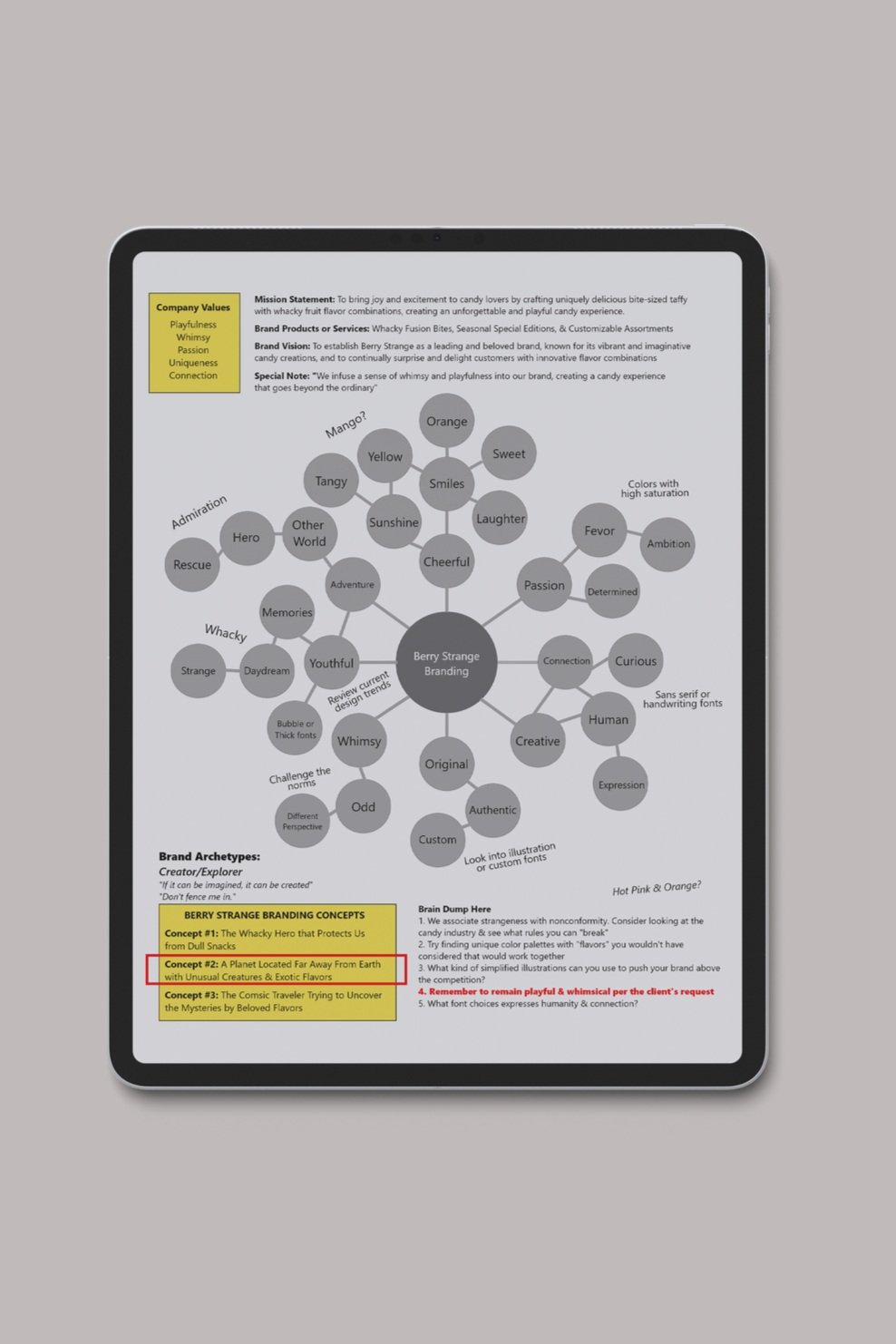
Mind-Map Mockup for BerryStrange
During market research, we focus on 2-3 main competitors and check out their websites, social media, and ads. Our main goal is to see what they’re doing well and where our client can do better to attract their target customers. We noticed that their competitors tend to stick to what we jokingly call the “print color” palette—mainly yellow, blue, and red (technically it’s magenta), with the occasional brown or cream. Custom fonts are really popular, especially with candy brands that use wordmark systems, but some also combine mascots with wordmarks. The idea is to always “marry” the typography within the overall style. As for their marketing approach, candy brands usually base themselves on the Innocent/Child archetype, aiming to evoke feelings of joy, simplicity, and wonder. Candy is often sold as a fun escape that helps relieves stress.
Our client wanted to connect with an audience that cares about customization and having control over their flavor experiences, which set them apart from the competition. While other brands are trying to keep things simple, we embraced BerryStrange’s huge variety, giving their target folks the freedom to be the fun, creative weirdos they are!
Phase #2: building the brain
After we finished our research, we moved on to “Brand Profiling” — creating 2-3 custom brand character frameworks to help train our client in verbal and written communication. Brand profiling taps into the 12 brand archetypes (out of 60 total), which are based on Carl Jung’s psychology.
A brand archetype is basically a universal character framework that shapes a brand’s personality, voice, and emotional connection by linking it to familiar human traits and storytelling roles. This helps create a stronger bond with the audience. When you combine 2-3 of these templates, you can build rich, human brands that buyers want to connect with and buy from. Our team presented the profiles to BerryStrange and we eventually decided to land on the profile that allows them to have dialogue with their audiences that encourages creativity, experimentation, and bold fun.
We then kicked off their brand strategy document, covering things like their Core Identity, Audience Segments, Brand Messaging/Positioning, Core Beliefs, Storytelling Structures, Language Guidelines (Do’s & Don’ts), Social Media Guidelines, and Canned Communication (taglines, templated responses, etc). Our team creates strategy docs that act as a second brand and training guide all in one, helping management when they’re ready to grow their team. It also plays a big role in shaping brand visuals to make sure their tone and voice stay consistent across all brand interactions.
Phase #3: letting it bloom
With a solid foundation from phase 1-2, we can now jump into the fun part: creating the brand visual systems to be shown across all touchpoints! Mood boards help our team move quickly when coming up with 2 different art directions for BerryStrange to check out. We ended up leaning toward the second board, called “Sugar Nova,” which focused more on illustrative and storytelling elements instead of a minimalistic and more “modern” look.
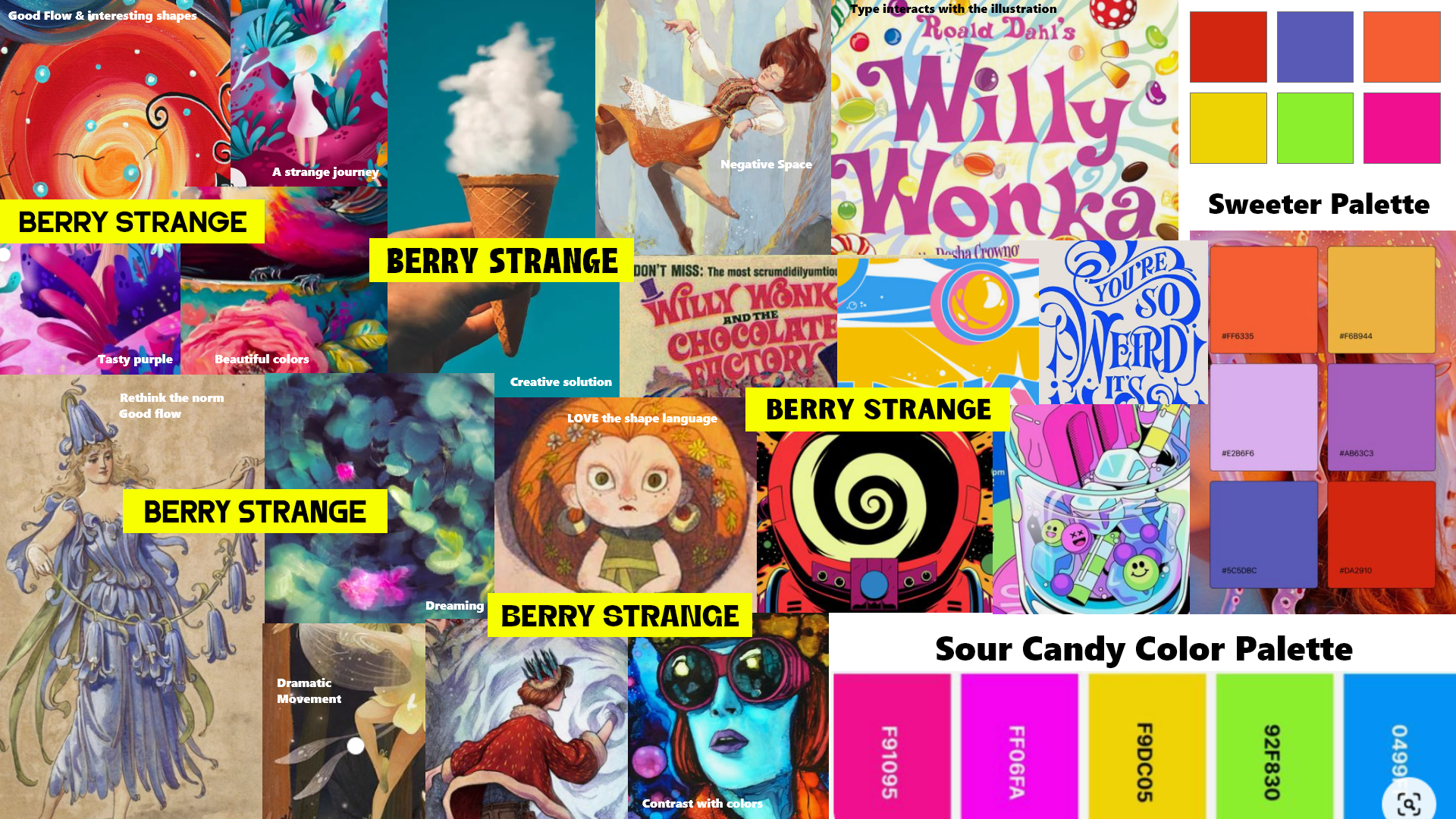
Chosen Mood Board for BerryStrange
With the direction chosen, we were free to begin experimenting with a candy mascot to help apply to other channels like animation & long forum video. We thoroughly enjoyed starting with fruit shapes and then combining different forms to create weird characters. This lead us to pitch the idea of “candy planet” where characters could live in different environment inspired by different flavor lines. A couple of promising characters were chosen to play with a few different
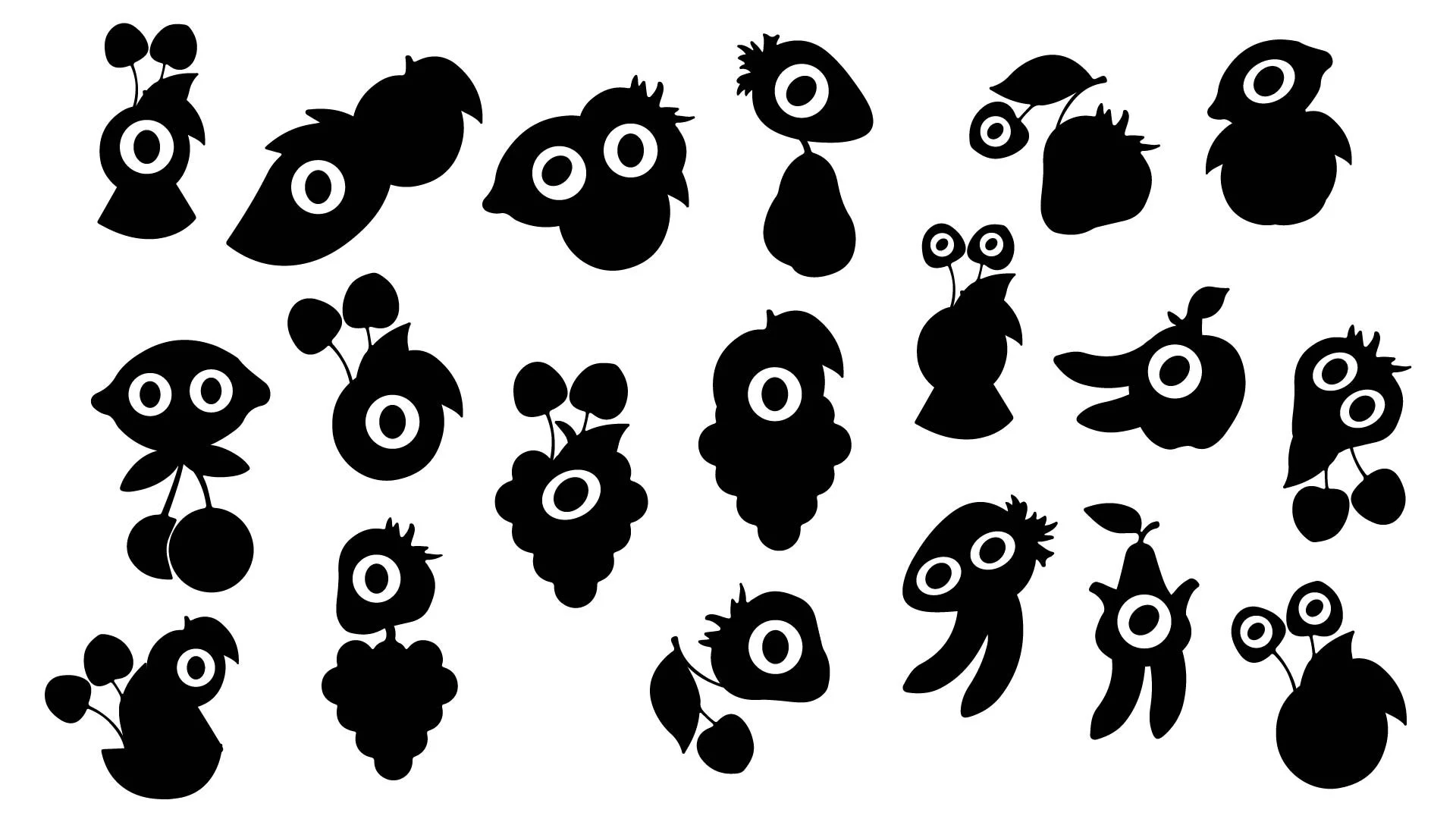
Having such unique shapes for mascots always presents a challenge with combining the word mark and symbol. We always want elements to “get along” rather than fight for the spotlight. All of these characters have just distinct outlines which express different modes of creativity and overall weirdness. The real question was which one was BerryStrange?
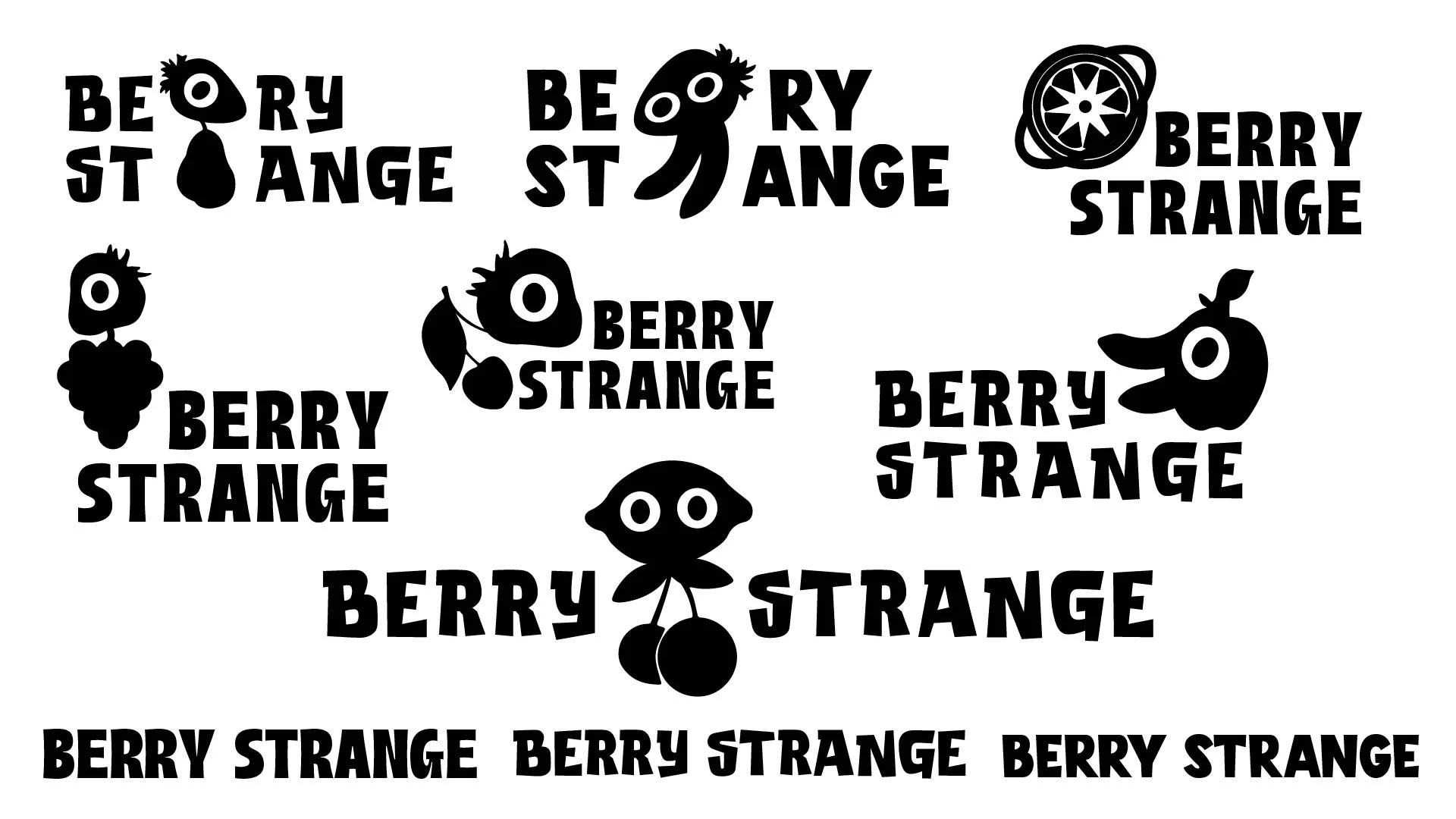
Of course, if you've checked out the project on our website, you already know who the winner is! Whompert, the Strawery, was picked to be the face of the brand, bringing all kinds of quirky fun to animation, merch design, and even packaging. His friends got fun names like Gabbie, Goober, Bloosh, Chermon, Bonkerz, Pearana, and even Splunk. The rest of the cast is still being considered by BerryStrange’s internal teams, and they’re excited to roll out some awesome campaigns!
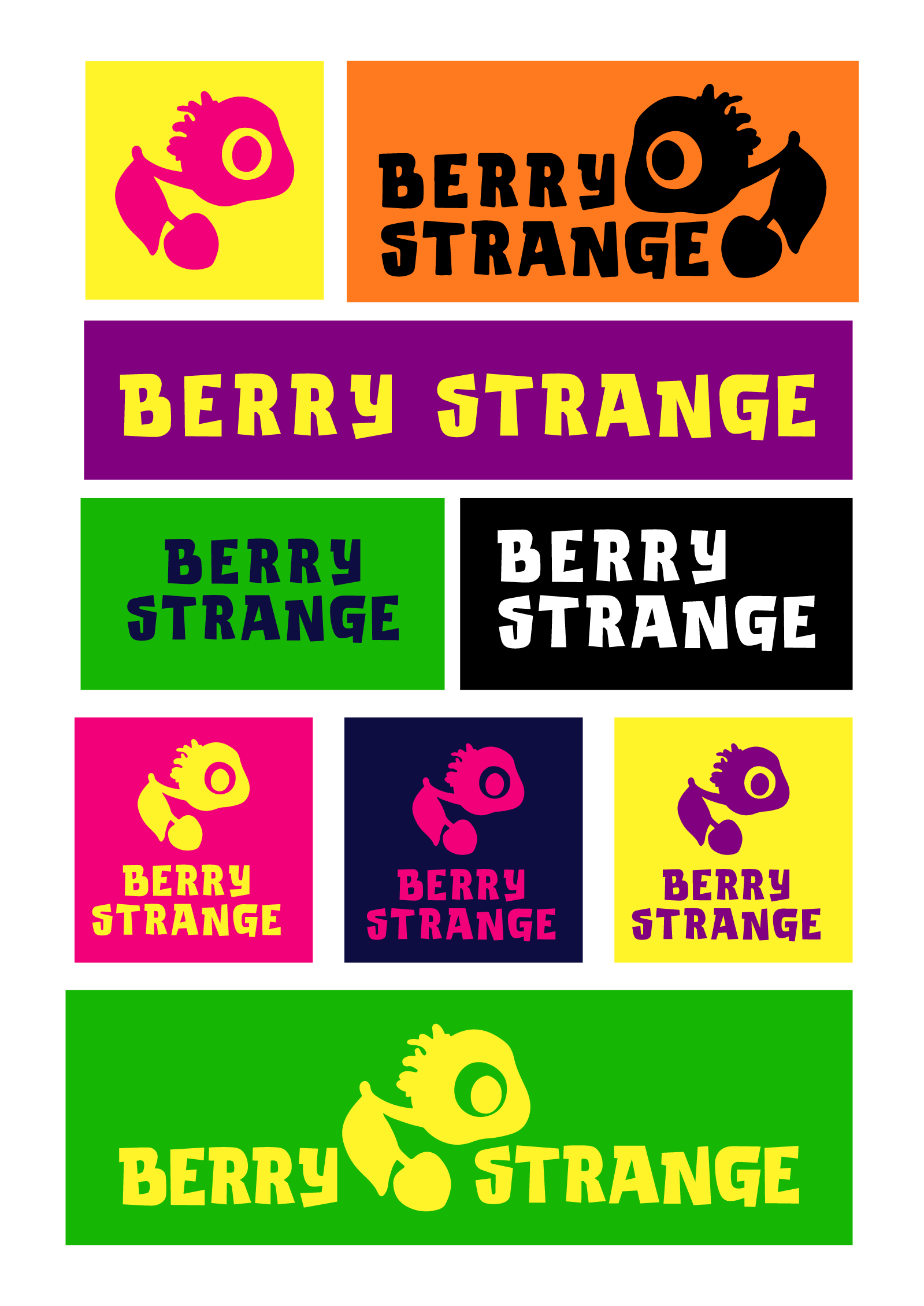
Believe it or not, one of the trickiest parts during the expression phase is getting teams to agree on the basic “rules” of their ecosystem. Picking fonts, colors, and illustrations can be challenging, and applying them across different channels has its own hurdles, but not nearly the same. Our team quickly puts together a one-page cheat sheet to refer to after client approval, while the rest of the brand style guide is being built. This helps us stay flexible if decisions change or certain elements need tweaking. As items get approved, we jot down the processes and make sure everything’s updated in the full brand bible (brand strategy + visual guide in one document).
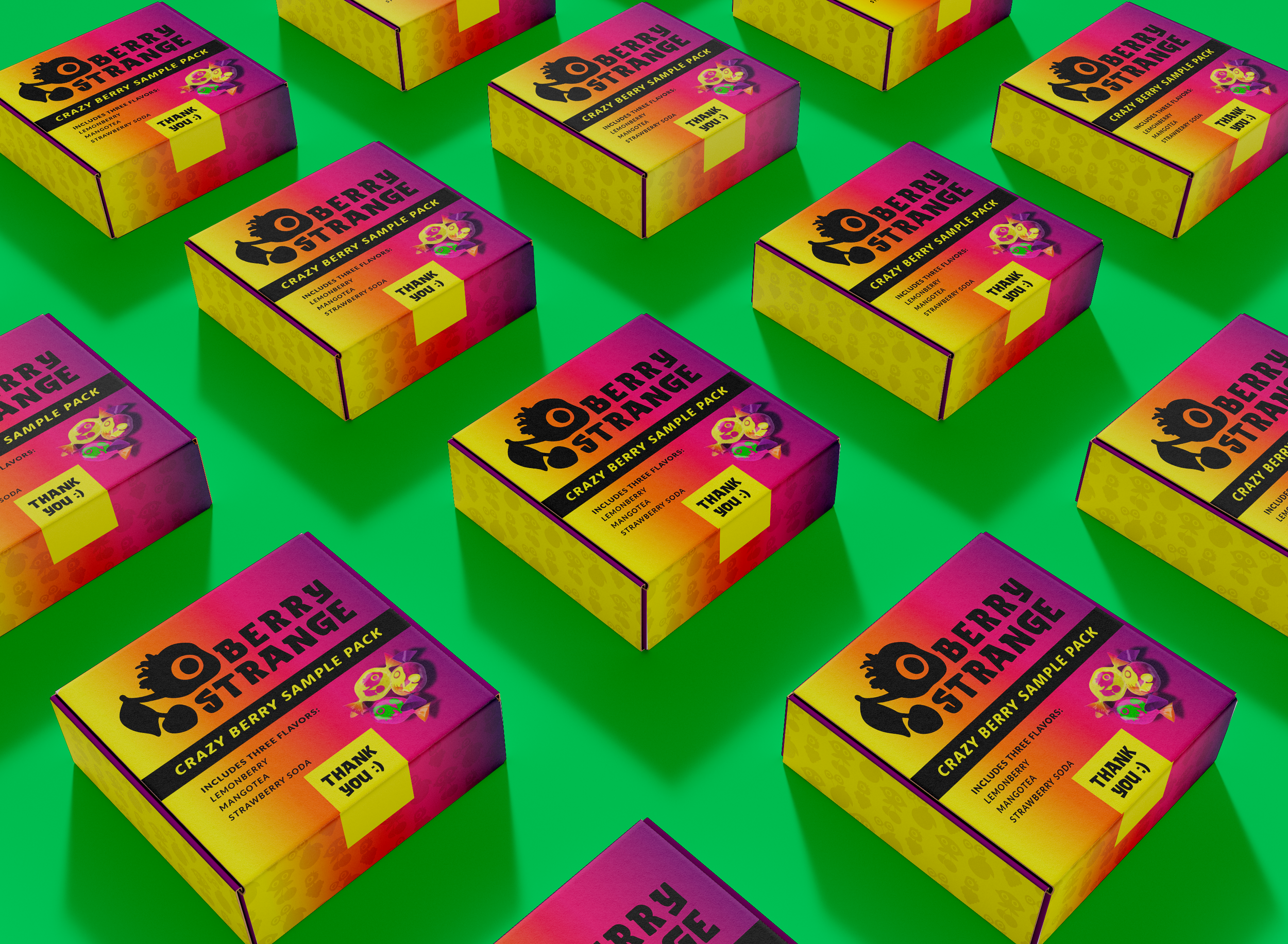
All files are uploaded to a digital cloud, and we share a download link with our clients when the project wraps up (always a bit bittersweet). We like to check back in on mature ecosystems to make sure our clients' frameworks are running smoothly both inside and out. If we did our job right, our clients might only need us when they want to update old processes or make small expansions. The Brand Ecology Method is designed to help our clients become independent from us so they can be the awesome founders we know they are.
FAQ: More about brand ecology
-
Not at all. Brand Ecology is just as powerful for growing businesses that want to scale intentionally as it is for businesses that feel stuck. In fact, the best time to invest in your brand ecosystem is before you hit a brand gap.
-
Every project is different, but the three-phase process is designed to be thorough without dragging on. Discovery and Strategy phases tend to take the most time because getting the foundation right is what makes everything else faster. Most clients find that having a solid strategy document cuts down on revision cycles significantly.
-
Brand Ecology is actually built with founders like you in mind. Getting clarity on your story, values, and audience early means you're not piecing together patchwork strategies later.
-
A rebrand typically focuses on updating visuals. Brand Ecology starts with research and strategy first, so the design decisions that follow are intentional, not just aesthetic. It's the difference between changing your outfit and actually understanding who you're dressing for.
-
Brand Ecology is about building the full system: the story, the positioning, the audience alignment, and the visual language that makes all of it work together. If you're attracting the wrong clients (or not enough of the right ones), your brand ecosystem probably needs more than a visual refresh.
Key Takeaways
Your brand is an ecosystem; every touchpoint, from a social post to a sales call, is part of the same living system. Treat it that way.
Research, storytelling, and design have to work together. Leave one out and your brand goes off balance. You’ll end up either too data-driven, too emotional, or too visually disconnected to build real trust from your clients.
People don't buy products or services. They buy the emotional relief they feel when you genuinely solve their problem. Your brand's job is to make that relief feel inevitable
Your client is the hero of the story, NOT you. The brands that convert position their client's transformation front and center, with your business playing the role of guide.
DIY branding has a ceiling. What got you here won't get you there — as expectations grow, your brand has to grow with them or it becomes the thing holding you back.
The "brand gap" is real and predictable. Most businesses outgrow their early branding around years 2–3. Building with strategy from the start is always cheaper than rebuilding after growth stalls.
Generic branding is actually the most expensive kind. When you try to speak to everyone, you spend more time, money, and energy chasing the wrong people, and still miss your ideal clients.
High traffic that doesn't convert isn't a marketing problem. It's actually an issue with your brand foundation. Inconsistent touchpoints create mixed messages, and mixed messages kill trust before a sale ever happens.
Your brand needs a brain, not just a face. Without solid frameworks and strategy documents that grow with your team, one unexpected market shift can knock the whole ecosystem off balance.
A brand built right filters the wrong clients out so the right ones can find you. That's not a side effect — that's the whole point.
work with us
*
work with us *

